Brain Workout

Brain Workout (M, 121): Compass

Body.Brain.ThinkIntroduction

  • Your mission is to fill every square in the diagram below with a different letter of the alphabet from A to K inclusive.
  • Use the clues to determine their locations.
  • Reference in the clues to ‘due’ means in any location along the same vertical or horizontal line.
  • Click the link below to view the correct positions.
  • Good luck!

Clues

  1. B is further north than J, which is due north of G.
  2. K is next to and west of E, which is next to and north of I, which is next to and north of A.
  3. D is due west of C, which is next to and north of F.
  4. C is next to and south of H, which is next to and east of G.

Diagram

Body.Brain.Workout.121

Click to view the correct answers (Member).

Brain Workout (M, 120): Path

Body.Brain.ThinkIntroduction

  • Your mission is to trace a single path from the top left corner to the bottom right corner of the grid.
  • Travel through all of the cells in either a horizontal, vertical or diagonal direction.
  • Every cell must be entered only once.
  • Your path should take you through the numbers in the sequence 1-2-3-4-5-6-1-2-3-4-5-6, and so on.
  • Click below to find the correct path.
  • Have fun and good luck!

Exercise(s)

Body.Brain.Workout.120

Click to view the correct answer (Member).

Brain Workout (M, 117): Elimination

Body.Brain.ThinkIntroduction

  • Your mission is to determine how many baskets that contained a mango, by doing some elimination.
  • Try solving the problem first with only your brain – no use of pen and paper, or other aid.
  • Good luck!

Exercise

Eighteen baskets of fruit were laid out for sale in a shop and each bore a unique number, 1 to 18 inclusive. All of the odd-numbered baskets held apples and no pears – and all of the even-numbered baskets held pears and no apples.

Any basket with a number lower than 9 held strawberries but no cherries – and any basket numbered 9 or higher held cherries but no strawberries. Any basket numbered 13 or lower held bananas but no apricots – and any basket numbered 14 or higher held apricots but no bananas.

A pineapple was placed into those baskets with both pears and bananas, as well as those baskets with both cherries and bananas, plus those with both apples and apricots – and a mango was placed into all of the remaining baskets.

How many baskets contained a mango?

Click to view the correct answer (Member).

Brain Workout (M, 109): Fill the Squares

Body.Brain.ThinkIntroduction

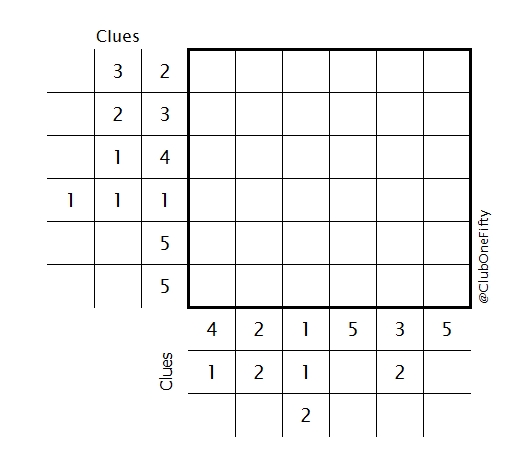
  • Your mission is to determine which of the squares in the grid that should be filled.
  • The clues list the groups of adjacent filled-out squares in each column and row. See the example.
  • Any adjacent filled squares must have at least one white square between them and the next set of adjacent filled squares.
  • Click the link below to view the correct answers.
  • Good luck!

Example

Body.Brain.Workout.109.Example

Mission

Body.Brain.Workout.109.Clues

Click to view the correct answers (Member).

Brain Workout (116): Elimination

Body.Brain.ThinkIntroduction

  • Your mission is to determine how many kids that painted a green star, by doing some elimination.
  • Try solving the problem first with only your brain – no use of pen and paper, or other aid.
  • Good luck!

Exercise

Fourteen children (half of whom are boys and half girls) drew a shape and painted it. Five of the boys are eight years old, as are two of the girls. Of the remaining children, one boy and three girls are nine years old and all of the others are ten years of age.

Three of the boys aged eight and half of the girls aged eight painted blue squares. Of those remaining, red circles were painted by one-third of the nine-year-old girls and half of the eight-year-old boys. Of those remaining, any ten-year-old painted a yellow triangle. The rest of the children painted a green star.

How many painted a green star?

Click to view the correct answer.

Brain Workout (M, 110): Sum It Up

Body.Brain.ThinkIntroduction

  • Your mission is to fill the blank squares with whole numbers.
  • The numbers should be between 1 and 20 inclusive and they may occur more than once or not at all.
  • Numbers in horizontal rows add up to the totals on the right, as do the diagonal lines.
  • Every vertical row add up to the totals along the bottom.
  • Click the link below to view the correct answers.
  • Stay concentrated and have fun!

Exercise

Body.Brain.Workout.110


Click to view the correct answers (Member).

Brain Workout (M, 108): Fill the Squares

Body.Brain.ThinkIntroduction

  • Your mission is to determine which of the squares in the grid that should be filled.
  • The clues list the groups of adjacent filled-out squares in each column and row. See the example.
  • Any adjacent filled squares must have at least one white square between them and the next set of adjacent filled squares.
  • Click the link below to view the correct answers.
  • Good luck!

Example

Body.Brain.Workout.108.Example

Mission

Body.Brain.Workout.108.Clues

Click to view the correct answers (Member).

Brain Workout (M, 103): Compass

Body.Brain.ThinkIntroduction

  • Your mission is to fill every square in the diagram below with a different letter of the alphabet from A to K inclusive.
  • Use the clues to determine their locations.
  • Reference in the clues to ‘due’ means in any location along the same vertical or horizontal line.
  • Click the link below to view the correct positions.
  • Good luck!

Clues

  1. A is next to and east of K, which is next to and south of E, which is further east than I.
  2. I is next to and north of B, which is next to and west of C, which is further north than J.
  3. F is next to and south of H, which is next to and east of J.
  4. G is due south of both A and D.

Diagram

Body.Brain.Workout.Compass.No176

Click to view the correct answers (Member).